
Article
How to choose the right lighting for your closet
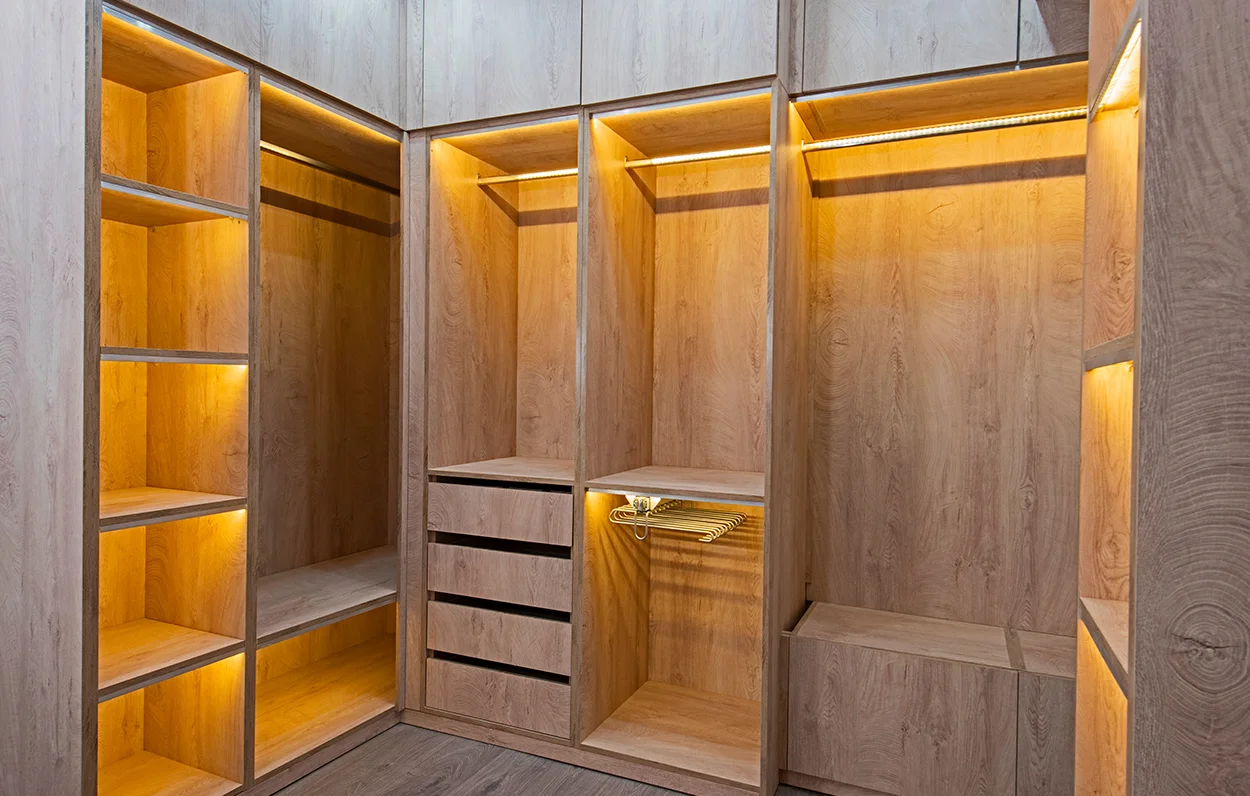
Custom made bedroom furniture can help you to maximise the storage capacity you can extract from the space you have available. But getting the right lighting for a closet is something that’s often overlooked.
Good lighting helps you to get the most out of your bespoke fitted furniture by illuminating all the corners that would otherwise be cast in darkness. By adding a little light inside, you can make it easier to find things and create a more stylish look for your closet.
If you engage the services of a fitted furniture supplier, they can talk through all the different lighting options with you and make suggestions based on the size, shape, style, and use of your made-to-measure bedroom furniture.
Here are some of the factors that need to be considered when choosing lighting for your closet.
How Bright Do You Need Your Closet Lighting to be?
We measure how bright something is in lumens. In a living room or bedroom, you’ll usually use around 10-20 lumens per square foot, though bathrooms and kitchens can require up to 80.
As a general rule, closets don’t need to be as bright as rooms. In a small bespoke wardrobe interior, you would typically only need 5-10 lumens per square foot. So in a 4-6 ft closet, you’d need between 60 and 250 lumens.
The number of lumens required per square foot increases in larger closets because their volume is considerably bigger in proportion to the area, creating more space to be illuminated.
Therefore, for a large 10 ft closet, you can expect to need up to 3,000 lumens.
Lighting Options
The lumens don’t all have to come from a single bulb, you can reach the required number by combining multiple light sources together. This gives you a lot of freedom to be creative with the way you light your custom made bedroom furniture.
Choosing Your Bulbs
In the past, there were only really two options but in recent years, we’ve seen a big increase in the number of different types of bulbs available for lighting our homes and closets. The main options are:
- Incandescent - The traditional type of bulb we’ve used for decades
- Fluorescent - The long tubes often used to light kitchens and offices
- Compact fluorescent lamps (CFL) - The bulbs often sold as “energy-saving”replacements for incandescent fittings
- LED - A bright, versatile, and low-energy lighting option Of course, you can use any of these options for lighting your closet, but there are some factors you need to take into consideration.
Firstly, incandescent bulbs can get quite hot, which may not make them practical or safe for use in a closet.
Fluorescent tubes and CFL bulbs don’t get as hot but they take up a lot of space, can take a while to get to full brightness, and can be broken easily.
LEDs can cost more upfront, but they’re significantly cheaper to run. They’re very bright from the moment they’re turned on and don’t get very hot, making them practical and safer. Not only that, but LEDs are much more versatile, allowing you to choose just about any colour imaginable and lay them out in different ways.
Once you’ve settled on a bulb type, you can examine your styling options.
Strip Lighting
Strip lighting is fast becoming one of the most popular choices for closet lighting because it allows for uniform illumination of an entire area and also looks great. Generally, strip lights are LEDs, so they’re cheap to run and can be battery operated.
Recessed Lights
Recessed lights are installed in a ceiling, wall, or closet surface. They have a great aesthetic and remove the risk of you banging your head or an object on them when you’re reaching into the closet.
Tracking Lights
Tracking lights are ones that have multiple individually-positioned bulbs attached to a single metal rail. They’re a popular choice because they can be repositioned to maximise the coverage of the bulbs. They work great in walk-in closets because they have a very modern and professional feel.
Pendants and Chandeliers
These are lights that hang from the ceiling and are the most common choice in the home. Chandeliers are essentially just fancy pendants, though they can both create a very elegant and classic look for your closet. They do, however, require more room than other options, so they work best in larger closets.
Automatic Lights
Most lighting options work with a switch that you manually activate with your hand. However, there are some automatic options that mean the contents of your closet will always be brightly lit up whenever you open the door. Some work off motion sensors, while others can have a switch that activates when the door opens, just like your fridge.
How to Power Your Closet Lighting
All lights need electricity to work, but how you get that energy to the bulb(s) will depend on how many lights you have, how bright they are, and whether you want to have an electrician run new cables through your walls.
Fitted bedrooms in London and other historic cities may be installed in old properties where it can be impractical to make new electrical installations. You may also not want to go through the trouble and expense of employing an electrician to do this.
In which case, “wireless” lights that are powered by batteries can work a treat. Because LEDs use very little energy, they can quite comfortably run on a couple of AA or AAA cells for months or even years without needing to be replaced.
If you opt for any of the other types of bulbs, you will almost certainly need them to be connected to the mains. This doesn’t necessarily mean they’ll have to be wired in by an electrician as they could be simply fitted into the custom-made bedroom furniture with a single cable running to a mains outlet. If you have a socket that’s nearby, then this can be a good option, but it won’t look great if you have to have a cable trailing across a room.
Need help creating the perfect fitted furniture design? TV and Media storage, Bespoke Headboards to complete the perfect bedroom, Get in touch today and our team will work with you to find the system that’s right for you.